The Höcke method: how half-truths become whole lies.
There are interviews that aren't dangerous because of the questions they ask, but because of their length. When someone is allowed to speak calmly, amiably, almost professorially for four or five hours, the viewer eventually gets the impression: anyone who talks for so long, who cites so many figures, who seems so controlled, can't be completely wrong. That's precisely the problem with the Höcke interview on Ben Unscripted. It's not a classic exchange of blows, not a tough political interrogation, but rather, for long stretches, a stage set. And on this stage, something happens that can't be dismissed with the simple word "lie." Höcke works more subtly. He takes real problems, genuine statistics, legitimate concerns--and shifts them around until they form a coherent picture of doom.
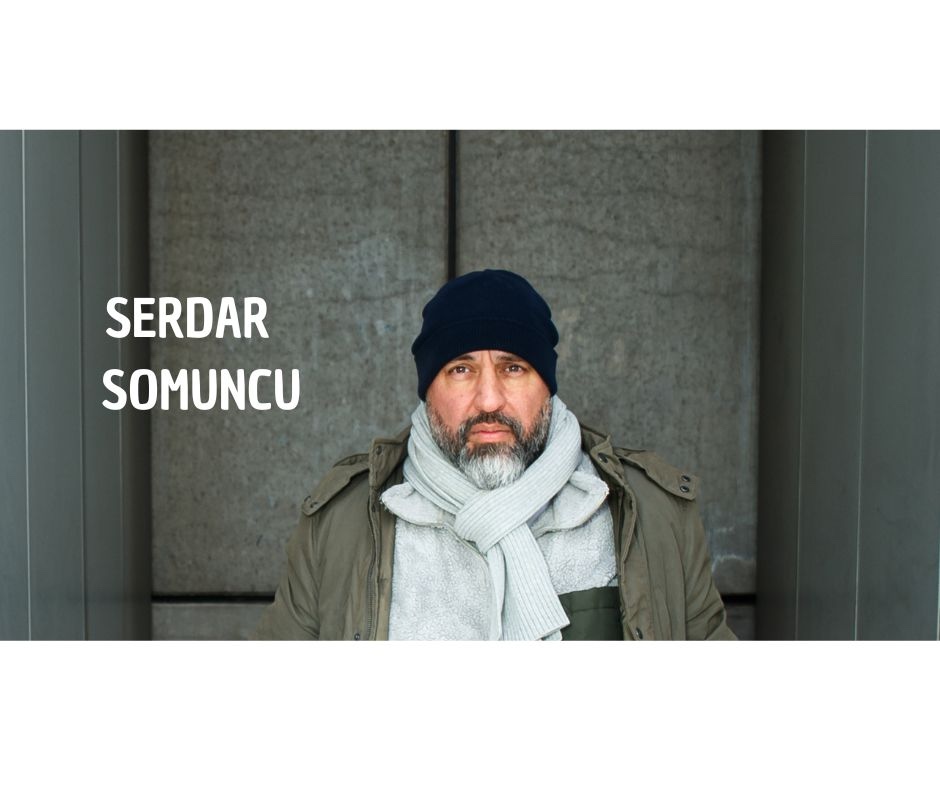
By Serdar Somuncu
By Serdar Somuncu
That's the core of his method: He doesn't simply invent everything. That would be too easy to refute. He uses figures that have some basis in reality, but he isolates them from their context. Then he connects them to terms like "people," "identity," "foreign infiltration," "implosion," "system failure," or "loss of control." Ultimately, the objective question of how migration, the welfare state, education, or crime actually function is no longer the focus, but rather a political narrative: Germany is being destroyed from within and without. This narrative sounds dramatic. But it isn't supported by the figures.
Let's take the first major point: migration. Höcke speaks as if Germany were experiencing an unchecked, constantly escalating influx. The figures tell a different story. According to the Federal Statistical Office, around 1.694 million people immigrated to Germany in 2024, while around 1.264 million people emigrated. This results in a net migration of approximately 430,000 people. In 2023, net immigration was still around 663,000. This means that net immigration remained high, but it has decreased significantly. Anyone who construes this as an uncontrolled explosion is not describing the statistics, but rather their own political agenda.
The same pattern can be seen in the asylum figures. In 2025, according to the Federal Office for Migration and Refugees (BAMF), a total of 168,543 asylum applications were submitted in Germany, of which 113,236 were initial applications and 55,307 were subsequent applications. Compared to 2024, this represents a decrease of 32.8 percent. Here, too, the sobering truth is more complex than Höcke's narrative: Yes, Germany has a significant number of asylum applications. No, the trend for 2025 does not show an ever-increasing loss of control. It shows a clear decline.
The distortion becomes particularly transparent when it comes to asylum law. Höcke likes to use the figure that only a very small proportion of applicants are recognized as politically persecuted under Article 16a of the Basic Law. This figure may be correct in a narrow legal sense. However, it is highly misleading as a political argument. Protection in Germany is not only granted under Article 16a, but also under the Geneva Refugee Convention, subsidiary protection, and national deportation bans. The overall protection rate was 28.1 percent in 2025. In 2024, it was 44.4 percent, and in 2023, 51.7 percent. Anyone who cites only Article 16a is acting as if almost all asylum seekers are illegitimate. In fact, in 2025, more than one in four decided cases received protection, and in previous years, the figures were significantly higher.
This is no small difference. This is the difference between legal accuracy and political deception. Höcke isn't necessarily saying something completely false. He's saying something that only works because he omits the crucial context. This is precisely how propaganda works in modern guise: you don't lie outright, you distort the truth until it appears to be a lie.
He proceeds similarly with the citizen's income. The narrative goes: The German welfare state is being plundered by immigrants. The figure circulating is roughly: almost half or more than half of citizen's income recipients are foreigners. What is reliable is that at the end of 2025, around 2.425 million citizen's income recipients had foreign citizenship, which corresponded to about 46.8 percent. That is a high number and it must be discussed politically. But it is not "well over 50 percent." And above all, "foreign citizenship" does not automatically mean "recently immigrated," not automatically "asylum seeker," not automatically "unwilling to work," and certainly not automatically "welfare cheat."
Even more importantly: This figure initially only tells us who is receiving benefits. It does not say why people are receiving benefits. It says nothing about access to the labor market, language skills, recognition of foreign qualifications, childcare, war refugees, trauma, place of residence, age, health, or bureaucratic hurdles. Höcke reduces all of this to an ethnic interpretation. The problem is not described as a social policy, educational policy, or labor market policy issue, but rather as proof that "the foreigners" are overburdening the country. That is the ideological leap.
He also employs a typical conflation when it comes to education and qualifications. When it is claimed that a very large proportion of immigrants have "neither school nor vocational training," it sounds like a comprehensive lack of educational attainment. In fact, older figures from the Federal Agency for Civic Education (bpb) for 2019 show that 12.8 percent of people with a migration background had no general school-leaving certificate, and 36.7 percent had no vocational qualification. This is a real integration problem. But it is not the same as "neither school nor vocational training." School-leaving certificates and vocational qualifications are two different categories. Anyone who rhetorically conflates them is making a fundamental mistake.Höcke turns a nuanced finding into a sweeping condemnation.
This is precisely where a serious debate should begin. Why are professional qualifications less common among certain groups? What role do country of origin, age at immigration, language, social background, school attendance in Germany, recognition procedures, and discrimination play? Höcke isn't interested in these questions because they disrupt his worldview. A complex reality demands solutions. His worldview demands scapegoats.
This also applies to the number of people with a migration background. According to the Federal Statistical Office, around 21.8 million people with a migration background lived in Germany in 2025. This corresponded to 26.3 percent of the population in private households with their primary residence. This number is large. But it is not automatically proof of a crisis. It primarily describes a social reality: Germany has been a country of immigration for decades. Among these 21.8 million are people born here, people who have lived here for decades, people with German passports, entrepreneurs, doctors, workers, artists, teachers, caregivers, taxpayers, children, and pensioners. Höcke's rhetoric turns this heterogeneous reality into a monolith. And from this monolith, he creates a threat.
This method becomes most dangerous when it comes to the topic of crime. Here, Höcke works with the strongest emotion: fear. He talks about violence, knives, rape, imported crime, and loss of control. There are real problems here, too. No one should pretend that all debates about crime are racist. Non-German suspects are overrepresented in certain categories of offenses. This must be acknowledged. But it's equally important to explain what these figures mean--and what they don't mean.
According to the German government, the 2025 police crime statistics show that registered crime decreased by 1.7 percent overall. Violent crime declined by 2.3 percent. Among suspected immigrant offenders in violent crimes, there was even a decrease of 7.2 percent. At the same time, the proportion of non-German suspects remains high in certain areas. This is reality: not a harmless situation, but also not a linear escalation to state collapse.
Höcke selects only the parts of this reality that fit his narrative. Overrepresentation: yes. Declines: rather not. Social factors: no. Age structure: no. Gender distribution: no. Residency status: only when it suits his narrative. Unreported crime and reporting behavior: no. Difference between foreigner, immigrant, suspect, and convicted person: no. The result is an emotionally charged picture in which every individual case becomes proof of an overall thesis. Statistics are transformed into sentiment.
Yet the distinction between suspects and perpetrators is crucial. Police crime statistics record suspects, not those who have not been legally convicted. Furthermore, they are only statistics based on reported crime: they show what the police are aware of. They do not measure the entirety of crime. Anyone who ignores these limitations turns a police tool into a political weapon. That's precisely what's happening with Höcke.
And then comes the major rhetorical leap: Individual figures are transformed into the claim that the state is on the verge of implosion. This claim is the real deception. Because none of the reliable figures support this diagnosis. Net immigration has decreased. Asylum applications fell significantly in 2025. The overall protection rate shows that a significant proportion of applicants actually have grounds for protection. Crime decreased overall in 2025. Violent crime decreased. Even where problems are real, it doesn't follow that Germany is collapsing.
Höcke's language is apocalyptic because it's politically useful. Anyone who talks about reforms has to explain how they intend to improve things. Anyone who talks about downfall only has to say who is to blame. That's the difference between politics and a salvation fantasy. Höcke offers no sober solution to problems, but rather a purification narrative: If we only get rid of the foreigners, if we only eliminate the elites, if we only restore the people to themselves, then everything will be alright. This is not analysis. This is mythology.
The interview is so effective precisely because Höcke rarely shouts. He doesn't need to shout. He speaks calmly, often seemingly erudite, with historical digressions, with figures, with terms that sound profound. This calmness is part of the performance. It is meant to normalize the radical content. Speaking calmly about nationalist categories doesn't make them harmless. It makes them more palatable.
That's precisely why it's not enough to simply call Höcke a "Nazi." That may be morally understandable, but it's insufficient from a journalistic perspective. One must show how his thinking works. It worksHöcke's argument is characterized by a constant shift from the social to the ethnic. Basic income is no longer a question of the labor market and poverty, but a question of origin. Education is no longer a question of school, language, and social status, but a question of cultural inferiority. Crime is no longer a complex field involving age, gender, background, control, and prosecution, but a question of otherness. Democracy is no longer a contested system, but a supposed facade. This creates a closed worldview in which every statistic ultimately serves only as evidence for a predetermined thesis.
This is the crucial point: Höcke's argument is not truly inductive. He doesn't look at reality and form an opinion from it. He has an opinion and selects from reality the material that fits it. Anything that contradicts it is omitted. What fits is amplified. What is unclear is emotionally charged. What is complex is categorized as friend or foe.
The most insidious form of this method is the half-truth. An outright lie is vulnerable to challenge. A half-truth is more robust because you can always say, "But the number is correct." Yes, the number might be correct. But the conclusion could still be wrong. It might be true that many recipients of basic income support are foreign nationals. This doesn't mean that foreigners are destroying the welfare state. It might be true that people with a migration background are more likely to lack vocational qualifications. This doesn't mean that they are incapable of learning or culturally incompatible. It might be true that non-German suspects are overrepresented in certain crime categories. This doesn't mean that migration as a whole is synonymous with crime. It might be true that the recognition rate under Article 16a is low. This doesn't mean that almost all asylum seekers are ineligible.
This very difference must be emphasized again and again. Because it is there, in this gap between number and interpretation, that the manipulation takes place.
You can't refute Höcke by claiming that there are no problems. That would be foolish and unbelievable. Of course there are problems. There are failures in integration. There are Overwhelmed municipalities. There are schools left to cope with language deficiencies on their own. There are parallel societies. There is violent crime. There are people who exploit the asylum system. There are welfare state costs that need to be explained and limited. Anyone who denies this is handing the field to Höcke.
But the second sentence must be added: Höcke's worldview does not stem from these problems. Ethnic sorting does not follow from them. Not authoritarian yearning. Not nationalist politics. Not the narrative of a dying Germany. From them follows tough, concrete, pragmatic policies: better schools, faster procedures, consistent deportation when there is no entitlement to protection, faster labor market integration, clear rules, relief for municipalities, combating clan structures, but also protection for the persecuted, naturalization for those with ties, integration for those who stay, and democratic firmness against all those who despise the state--regardless of whether their name is Mohammed, Björn, or Kevin.
This is the point at which Höcke's narrative collapses. He claims he speaks He reveals what others keep silent about. In truth, he himself conceals the crucial point: that reality doesn't fit his nationalist mold. Germany is not "a people" in the romantic sense, contaminated by foreigners. Germany is a modern constitutional state with a historically developed population, an aging society, a need for labor, social tensions, cultural conflicts, and democratic institutions. This is challenging. But it is not apocalyptic.
Höcke thrives politically on people mistaking effort for doom. He takes real hardships and imbues them with metaphysical significance. An overwhelmed immigration office becomes a sign of state collapse. A knife attack becomes a symbol for migration as a whole. A citizen's benefit statistic becomes proof of national plunder. A school statistic becomes evidence of cultural incompatibility. This creates a self-immunizing worldview: Every piece of bad news confirms it. Every piece of good news is dismissed as a lie perpetrated by the system.
Therefore, this interview must be criticized not only for its content but also for its form. Form is part of content. A conversation in which a radical politician can spout his rhetoric for hours distorts perception. The lack of interruption creates the illusion of agreement. The calm atmosphere of the conversation creates the illusion of normality. The length creates the illusion of depth. But length is not truth. Calmness is not proof. And numbers are not arguments as long as they are incorrectly combined.
If you truly dissect Höcke, what remains is not the great enlightener, but a complete idiot.A clever engineer. He's building a fake house from real fragments. A few bricks are real. The blueprint is ideological. That's precisely why his rhetoric is so dangerous: it's not entirely fabricated, but half true, half distorted, utterly poisonous.
The counter-argument must therefore be more precise than the outrage. It must say: Yes, there are problems. Yes, certain figures are high. Yes, integration hasn't automatically succeeded. Yes, the state has made mistakes. But no, that doesn't lead to Höcke's diagnosis. No, Germany isn't on the verge of implosion. No, migration doesn't explain everything. No, the people aren't a biological or ethnic community bound by fate. No, democracy isn't only democracy when Höcke wins.
And perhaps that's the most important lesson from this interview: you can't give an authoritarian politician the stage and hope that his radicalism will become apparent on its own. It won't. It disguises itself as reason. It speaks softly. It cites figures. It smiles. It waits until no one asks any questions.
That's why we have to ask questions. Again and again. Which number? From which year? Which category? Suspects or convicted criminals? Foreigners or immigrants? Article 16a or overall protection rate? Gross immigration or net immigration? School leaving certificate or vocational qualification? Isolated incident or trend? Problem or downfall?
These questions are where Höcke's method falls apart. Not because all his figures are wrong. But because his version of the truth only works as long as no one looks closely.
May 4, 2026
©Serdar Somuncu
"The new book - Lies - A Cultural History of a Human Weakness"
*Serdar Somuncu is an actor and directord director
LINK TO THE NEW BOOK
Let's take the first major point: migration. Höcke speaks as if Germany were experiencing an unchecked, constantly escalating influx. The figures tell a different story. According to the Federal Statistical Office, around 1.694 million people immigrated to Germany in 2024, while around 1.264 million people emigrated. This results in a net migration of approximately 430,000 people. In 2023, net immigration was still around 663,000. This means that net immigration remained high, but it has decreased significantly. Anyone who construes this as an uncontrolled explosion is not describing the statistics, but rather their own political agenda.
The same pattern can be seen in the asylum figures. In 2025, according to the Federal Office for Migration and Refugees (BAMF), a total of 168,543 asylum applications were submitted in Germany, of which 113,236 were initial applications and 55,307 were subsequent applications. Compared to 2024, this represents a decrease of 32.8 percent. Here, too, the sobering truth is more complex than Höcke's narrative: Yes, Germany has a significant number of asylum applications. No, the trend for 2025 does not show an ever-increasing loss of control. It shows a clear decline.
The distortion becomes particularly transparent when it comes to asylum law. Höcke likes to use the figure that only a very small proportion of applicants are recognized as politically persecuted under Article 16a of the Basic Law. This figure may be correct in a narrow legal sense. However, it is highly misleading as a political argument. Protection in Germany is not only granted under Article 16a, but also under the Geneva Refugee Convention, subsidiary protection, and national deportation bans. The overall protection rate was 28.1 percent in 2025. In 2024, it was 44.4 percent, and in 2023, 51.7 percent. Anyone who cites only Article 16a is acting as if almost all asylum seekers are illegitimate. In fact, in 2025, more than one in four decided cases received protection, and in previous years, the figures were significantly higher.
This is no small difference. This is the difference between legal accuracy and political deception. Höcke isn't necessarily saying something completely false. He's saying something that only works because he omits the crucial context. This is precisely how propaganda works in modern guise: you don't lie outright, you distort the truth until it appears to be a lie.
He proceeds similarly with the citizen's income. The narrative goes: The German welfare state is being plundered by immigrants. The figure circulating is roughly: almost half or more than half of citizen's income recipients are foreigners. What is reliable is that at the end of 2025, around 2.425 million citizen's income recipients had foreign citizenship, which corresponded to about 46.8 percent. That is a high number and it must be discussed politically. But it is not "well over 50 percent." And above all, "foreign citizenship" does not automatically mean "recently immigrated," not automatically "asylum seeker," not automatically "unwilling to work," and certainly not automatically "welfare cheat."
Even more importantly: This figure initially only tells us who is receiving benefits. It does not say why people are receiving benefits. It says nothing about access to the labor market, language skills, recognition of foreign qualifications, childcare, war refugees, trauma, place of residence, age, health, or bureaucratic hurdles. Höcke reduces all of this to an ethnic interpretation. The problem is not described as a social policy, educational policy, or labor market policy issue, but rather as proof that "the foreigners" are overburdening the country. That is the ideological leap.
He also employs a typical conflation when it comes to education and qualifications. When it is claimed that a very large proportion of immigrants have "neither school nor vocational training," it sounds like a comprehensive lack of educational attainment. In fact, older figures from the Federal Agency for Civic Education (bpb) for 2019 show that 12.8 percent of people with a migration background had no general school-leaving certificate, and 36.7 percent had no vocational qualification. This is a real integration problem. But it is not the same as "neither school nor vocational training." School-leaving certificates and vocational qualifications are two different categories. Anyone who rhetorically conflates them is making a fundamental mistake.Höcke turns a nuanced finding into a sweeping condemnation.
This is precisely where a serious debate should begin. Why are professional qualifications less common among certain groups? What role do country of origin, age at immigration, language, social background, school attendance in Germany, recognition procedures, and discrimination play? Höcke isn't interested in these questions because they disrupt his worldview. A complex reality demands solutions. His worldview demands scapegoats.
This also applies to the number of people with a migration background. According to the Federal Statistical Office, around 21.8 million people with a migration background lived in Germany in 2025. This corresponded to 26.3 percent of the population in private households with their primary residence. This number is large. But it is not automatically proof of a crisis. It primarily describes a social reality: Germany has been a country of immigration for decades. Among these 21.8 million are people born here, people who have lived here for decades, people with German passports, entrepreneurs, doctors, workers, artists, teachers, caregivers, taxpayers, children, and pensioners. Höcke's rhetoric turns this heterogeneous reality into a monolith. And from this monolith, he creates a threat.
This method becomes most dangerous when it comes to the topic of crime. Here, Höcke works with the strongest emotion: fear. He talks about violence, knives, rape, imported crime, and loss of control. There are real problems here, too. No one should pretend that all debates about crime are racist. Non-German suspects are overrepresented in certain categories of offenses. This must be acknowledged. But it's equally important to explain what these figures mean--and what they don't mean.
According to the German government, the 2025 police crime statistics show that registered crime decreased by 1.7 percent overall. Violent crime declined by 2.3 percent. Among suspected immigrant offenders in violent crimes, there was even a decrease of 7.2 percent. At the same time, the proportion of non-German suspects remains high in certain areas. This is reality: not a harmless situation, but also not a linear escalation to state collapse.
Höcke selects only the parts of this reality that fit his narrative. Overrepresentation: yes. Declines: rather not. Social factors: no. Age structure: no. Gender distribution: no. Residency status: only when it suits his narrative. Unreported crime and reporting behavior: no. Difference between foreigner, immigrant, suspect, and convicted person: no. The result is an emotionally charged picture in which every individual case becomes proof of an overall thesis. Statistics are transformed into sentiment.
Yet the distinction between suspects and perpetrators is crucial. Police crime statistics record suspects, not those who have not been legally convicted. Furthermore, they are only statistics based on reported crime: they show what the police are aware of. They do not measure the entirety of crime. Anyone who ignores these limitations turns a police tool into a political weapon. That's precisely what's happening with Höcke.
And then comes the major rhetorical leap: Individual figures are transformed into the claim that the state is on the verge of implosion. This claim is the real deception. Because none of the reliable figures support this diagnosis. Net immigration has decreased. Asylum applications fell significantly in 2025. The overall protection rate shows that a significant proportion of applicants actually have grounds for protection. Crime decreased overall in 2025. Violent crime decreased. Even where problems are real, it doesn't follow that Germany is collapsing.
Höcke's language is apocalyptic because it's politically useful. Anyone who talks about reforms has to explain how they intend to improve things. Anyone who talks about downfall only has to say who is to blame. That's the difference between politics and a salvation fantasy. Höcke offers no sober solution to problems, but rather a purification narrative: If we only get rid of the foreigners, if we only eliminate the elites, if we only restore the people to themselves, then everything will be alright. This is not analysis. This is mythology.
The interview is so effective precisely because Höcke rarely shouts. He doesn't need to shout. He speaks calmly, often seemingly erudite, with historical digressions, with figures, with terms that sound profound. This calmness is part of the performance. It is meant to normalize the radical content. Speaking calmly about nationalist categories doesn't make them harmless. It makes them more palatable.
That's precisely why it's not enough to simply call Höcke a "Nazi." That may be morally understandable, but it's insufficient from a journalistic perspective. One must show how his thinking works. It worksHöcke's argument is characterized by a constant shift from the social to the ethnic. Basic income is no longer a question of the labor market and poverty, but a question of origin. Education is no longer a question of school, language, and social status, but a question of cultural inferiority. Crime is no longer a complex field involving age, gender, background, control, and prosecution, but a question of otherness. Democracy is no longer a contested system, but a supposed facade. This creates a closed worldview in which every statistic ultimately serves only as evidence for a predetermined thesis.
This is the crucial point: Höcke's argument is not truly inductive. He doesn't look at reality and form an opinion from it. He has an opinion and selects from reality the material that fits it. Anything that contradicts it is omitted. What fits is amplified. What is unclear is emotionally charged. What is complex is categorized as friend or foe.
The most insidious form of this method is the half-truth. An outright lie is vulnerable to challenge. A half-truth is more robust because you can always say, "But the number is correct." Yes, the number might be correct. But the conclusion could still be wrong. It might be true that many recipients of basic income support are foreign nationals. This doesn't mean that foreigners are destroying the welfare state. It might be true that people with a migration background are more likely to lack vocational qualifications. This doesn't mean that they are incapable of learning or culturally incompatible. It might be true that non-German suspects are overrepresented in certain crime categories. This doesn't mean that migration as a whole is synonymous with crime. It might be true that the recognition rate under Article 16a is low. This doesn't mean that almost all asylum seekers are ineligible.
This very difference must be emphasized again and again. Because it is there, in this gap between number and interpretation, that the manipulation takes place.
You can't refute Höcke by claiming that there are no problems. That would be foolish and unbelievable. Of course there are problems. There are failures in integration. There are Overwhelmed municipalities. There are schools left to cope with language deficiencies on their own. There are parallel societies. There is violent crime. There are people who exploit the asylum system. There are welfare state costs that need to be explained and limited. Anyone who denies this is handing the field to Höcke.
But the second sentence must be added: Höcke's worldview does not stem from these problems. Ethnic sorting does not follow from them. Not authoritarian yearning. Not nationalist politics. Not the narrative of a dying Germany. From them follows tough, concrete, pragmatic policies: better schools, faster procedures, consistent deportation when there is no entitlement to protection, faster labor market integration, clear rules, relief for municipalities, combating clan structures, but also protection for the persecuted, naturalization for those with ties, integration for those who stay, and democratic firmness against all those who despise the state--regardless of whether their name is Mohammed, Björn, or Kevin.
This is the point at which Höcke's narrative collapses. He claims he speaks He reveals what others keep silent about. In truth, he himself conceals the crucial point: that reality doesn't fit his nationalist mold. Germany is not "a people" in the romantic sense, contaminated by foreigners. Germany is a modern constitutional state with a historically developed population, an aging society, a need for labor, social tensions, cultural conflicts, and democratic institutions. This is challenging. But it is not apocalyptic.
Höcke thrives politically on people mistaking effort for doom. He takes real hardships and imbues them with metaphysical significance. An overwhelmed immigration office becomes a sign of state collapse. A knife attack becomes a symbol for migration as a whole. A citizen's benefit statistic becomes proof of national plunder. A school statistic becomes evidence of cultural incompatibility. This creates a self-immunizing worldview: Every piece of bad news confirms it. Every piece of good news is dismissed as a lie perpetrated by the system.
Therefore, this interview must be criticized not only for its content but also for its form. Form is part of content. A conversation in which a radical politician can spout his rhetoric for hours distorts perception. The lack of interruption creates the illusion of agreement. The calm atmosphere of the conversation creates the illusion of normality. The length creates the illusion of depth. But length is not truth. Calmness is not proof. And numbers are not arguments as long as they are incorrectly combined.
If you truly dissect Höcke, what remains is not the great enlightener, but a complete idiot.A clever engineer. He's building a fake house from real fragments. A few bricks are real. The blueprint is ideological. That's precisely why his rhetoric is so dangerous: it's not entirely fabricated, but half true, half distorted, utterly poisonous.
The counter-argument must therefore be more precise than the outrage. It must say: Yes, there are problems. Yes, certain figures are high. Yes, integration hasn't automatically succeeded. Yes, the state has made mistakes. But no, that doesn't lead to Höcke's diagnosis. No, Germany isn't on the verge of implosion. No, migration doesn't explain everything. No, the people aren't a biological or ethnic community bound by fate. No, democracy isn't only democracy when Höcke wins.
And perhaps that's the most important lesson from this interview: you can't give an authoritarian politician the stage and hope that his radicalism will become apparent on its own. It won't. It disguises itself as reason. It speaks softly. It cites figures. It smiles. It waits until no one asks any questions.
That's why we have to ask questions. Again and again. Which number? From which year? Which category? Suspects or convicted criminals? Foreigners or immigrants? Article 16a or overall protection rate? Gross immigration or net immigration? School leaving certificate or vocational qualification? Isolated incident or trend? Problem or downfall?
These questions are where Höcke's method falls apart. Not because all his figures are wrong. But because his version of the truth only works as long as no one looks closely.
May 4, 2026
©Serdar Somuncu
"The new book - Lies - A Cultural History of a Human Weakness"
*Serdar Somuncu is an actor and directord director
LINK TO THE NEW BOOK
Write a comment